In the first days after a death a family needs a handful of facts quickly: who to telephone, where the will is, which banks and pensions, who looks after the pets, and what you wanted. Write those on one dated document, keep it where they will look, and tell one person where it is. It should never contain a password or a full account number.
The first week, not the estate
A will decides who gets what, and it matters — but it is a slow document. It may not be read for days and probate can take months. The first week is a different problem entirely. Somebody has to register the death, ring an employer, stop a direct debit, find out whether you had already chosen a funeral director, and work out who is feeding the cat tonight.
Almost none of that is written down anywhere. It lives in one person's head, and that person is the one who has died.
The twelve that matter most
If you write nothing else, write these. Most people can do it in a quarter of an hour.
- Who to telephone first. One or two names and numbers, and how they are related to you.
- Where the will is, and the name of the solicitor or the executor.
- What you want done — buried, cremated, donated — and whether anything is already arranged and paid for.
- Which banks and building societies you use. The name and the branch, not the account number.
- Pensions, current and old, and who the provider is.
- Life insurance, and any death-in-service benefit through an employer.
- The mortgage, or the landlord, and where the paperwork lives.
- Who looks after the pets, what they eat, and the vet.
- Your employer, and who to tell.
- Where the papers are — deeds, certificates, the passport, the safe and its key.
- Your online life: which password manager, and where its emergency kit is kept.
- Where this document is kept, and who else holds a copy.
Never write down the secret
This is the part that goes wrong. A document that lists passwords, PINs and full account numbers is a document that sits in an unlocked drawer for a decade waiting for a burglar, a builder or a falling-out. It is also the reason most people never write anything at all: the task feels dangerous, so it never gets done.
The way out is simple. Write where things are, not what they are. A map is almost as useful to a family and close to useless to anyone else.
Safe to write
- The bank and the branch
- “Password manager: 1Password. Emergency kit in the green folder”
- The solicitor's firm and town
- “Life policy with Aviva, papers in the bureau”
- The vet's name
- Where the safe key is
Never write
- Passwords or PINs
- Full account or card numbers
- Your National Insurance or Social Security number
- The safe combination
- Security question answers
- Anything a stranger could use today
A family does not need to get into your bank account. They need to know that the account exists and which bank it is with. The rest is the bank's job, and they have done it thousands of times.
Where to keep it
Somewhere a grieving person will actually look, which usually means a drawer at home rather than anywhere clever. Give a second copy to the person you would want telephoned first. Tell them plainly that it exists.
A bank safety deposit box is a poor hiding place for this particular document, because it may not be opened until the estate is sorted out — long after the week it was written for. So is a locked phone that nobody else can open.
Put the date on it
An undated list is a trap. Facts rot: accounts close, providers merge, people move, executors die. Date every copy, look at it once or twice a year, and mark it checked when nothing has changed. A list that says plainly “last checked March 2026” tells a family how much to trust it.
The app that asks the questions
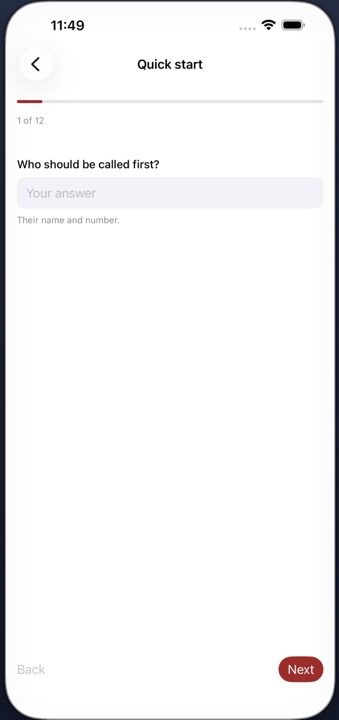
The hard part is not the writing. It is being asked the right questions in an order that does not feel like homework. When I Die: The Envelope asks them in plain words, one at a time, and turns the answers into a single printed document for the drawer.
The quick start is the twelve questions above and gives a first printable copy in about a quarter of an hour. The rest fills in at your own pace: health, money, home and bills, papers, things, pets, online life, final wishes, and a last section that asks nothing at all, for whatever you want to say in your own words.
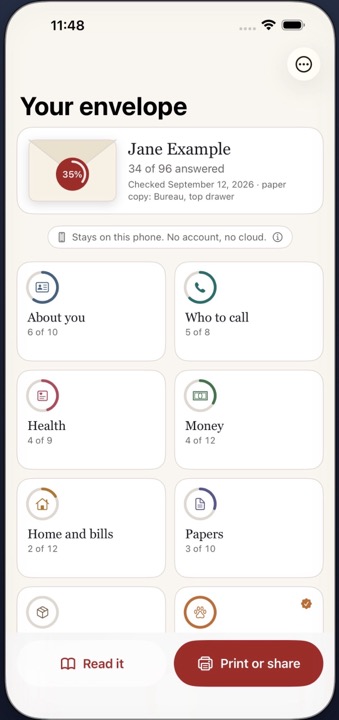
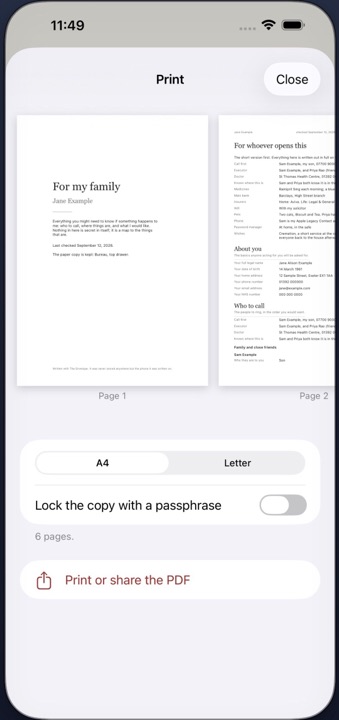
There is no field for a password, a PIN or a full account number anywhere in it, by design. Nothing is uploaded: no account, no cloud, no server. Reading the whole thing on screen in large plain type is free whether you buy anything or not, so somebody holding your phone at the worst possible moment can find what they need.

When I Die: The Envelope
Free to download, and reading it on screen is always free. One purchase prints the whole document, with no subscription. iPhone, worldwide, with separate question sets for the UK and the US.
Get it on the App StoreQuestions people ask
- Is this a will?
No, and it does not replace one. A will says who inherits; this says who to ring. If you want something to be legally binding, it belongs in a will drawn up properly.
- Should I include my passwords?
No. Name the password manager and say where its emergency kit is kept. That is the whole job.
- What if I do not have a will?
Then this matters more, not less — but it is not a substitute. Say so plainly on the document, so the family knows where they stand from the first page.
- How often should I go back to it?
Once or twice a year, and after any move, new job, new account, separation, birth or death.
- Is it legally binding?
No. It has no legal force at all. Its value is entirely practical.
- Is there an Android version?
No. It is an iPhone app only.
This page and the app are practical record-keeping, not legal or financial advice. Nothing here directs who inherits anything, and neither the page nor the app is a substitute for a will or for advice from a solicitor.