A board foot is 144 cubic inches of timber. Multiply thickness by width by length in inches and divide by 144; if the length is in feet, divide by 12 instead. Hardwood thickness is sold in quarters, so 4/4 is one inch and 8/4 is two. Measure the rough size, not the planed size.
The sum
Everything about board feet follows from one number. A board foot is a piece of timber one foot long, one foot wide and one inch thick: 12 × 12 × 1, which is 144 cubic inches. Every calculation is just that volume divided into the volume of the board in front of you.
A 2 by 4, eight feet long: 2 × 4 × 96 = 768 cubic inches, and 768 ÷ 144 = 5.33 board feet. The same board using the second form: 2 × 4 × 8 ÷ 12 = 5.33. They are the same sum wearing different clothes.
What the quarters mean
Hardwood is not sold in nominal sizes the way construction softwood is. It is sold in quarters of an inch of thickness, and the yard says the fraction out loud: four quarter, five quarter, eight quarter.
| Written | Said | Rough thickness | Typical use |
|---|---|---|---|
| 4/4 | four quarter | 1" | Panels, drawer sides, most furniture parts |
| 5/4 | five quarter | 1 1/4" | Stair treads, worktops, thicker tops |
| 6/4 | six quarter | 1 1/2" | Table aprons, heavier frames |
| 8/4 | eight quarter | 2" | Legs, chair parts, turning stock |
| 12/4 | twelve quarter | 3" | Heavy legs, bench tops |
| 16/4 | sixteen quarter | 4" | Posts, large turning blanks |
Rough, not finished
This is where most of the money goes missing. A 4/4 board that has been planed on both faces measures about thirteen sixteenths of an inch, but it is still bought, sold and charged for as 4/4. You pay for the wood the saw cut, not the wood left after the planer. Unless the yard tells you otherwise, measure the rough thickness, and take the width at the narrowest point of the board.
Waste is not optional
Rough boards are wany-edged, cupped and split at the ends. A cutting list of exactly 40 board feet needs more like 50 to 60 board feet of rough stock, depending on how wide the parts are and how fussy the grain match is. Work out the parts, then add the allowance before you go to the yard, not after.
Log rules, and why three of them disagree
A board in a rack can be measured. A log cannot, because nobody yet knows how it will be sawn. A log rule is an estimate of how many board feet a log of a given small-end diameter and length ought to yield. Three are still in everyday use in the United States, and they do not agree with each other.
| Rule | How it behaves | Usually favours |
|---|---|---|
| Doyle | Badly underestimates small logs, and flatters large ones. The error on a 12 inch log is severe. | The buyer |
| Scribner | A diagram rule. Sits between the other two, and is close on mid-size logs. | Neither, roughly |
| International 1/4" | Built from an actual sawing model with a quarter-inch kerf. The closest of the three to real yield, and the one used for research and inventory. | The seller, relative to Doyle |
None of them is the right answer in the abstract. The right one is whichever the contract or the buyer names. What matters is knowing which one you are being quoted in, because the same log can differ by a third between Doyle and International.
The app that does it while you stand at the rack
Board Foot Tally is the sum above with the arithmetic taken away. Pick the thickness in quarters, then type the width and the length the way they are written on the board — 5 1/2, or 2' 6 3/4 — and the board feet, the waste allowance and the cost appear as you type. Add each board to a tally, mix species and prices in one project, and walk out of the yard with a total you can hand over.
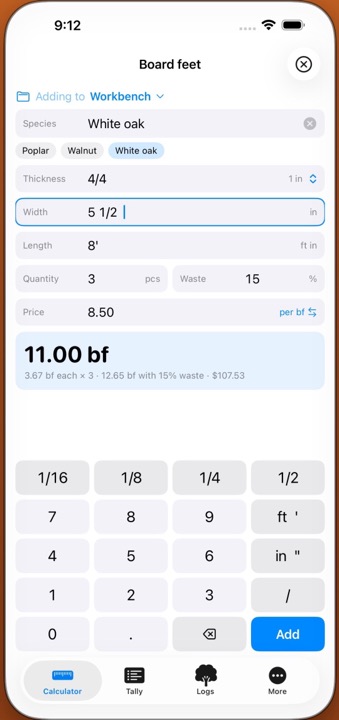
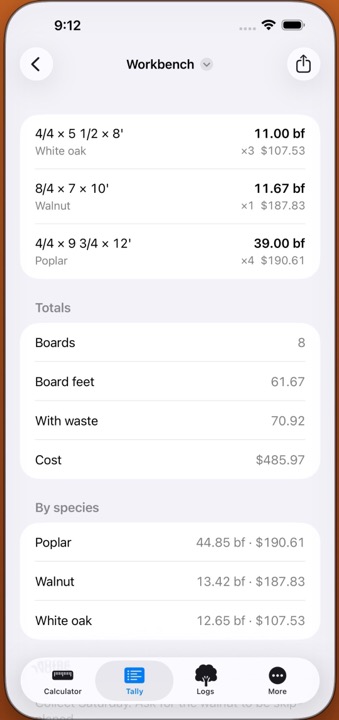
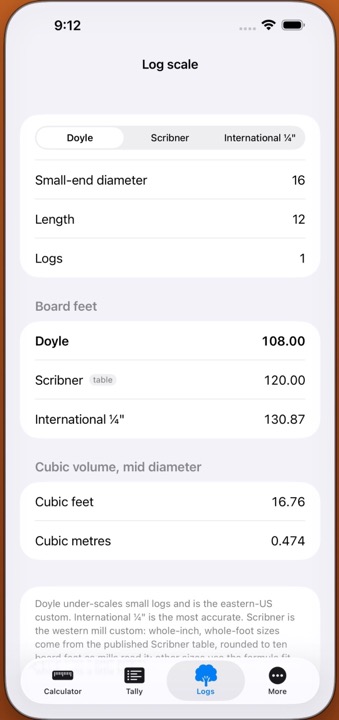
It works in inches and feet or in millimetres and metres, shows its working on every result, and exports a project to PDF or CSV. Nothing leaves the phone, there are no ads and no account, and Pro is one purchase rather than a subscription.

Board Foot Tally & Calculator
Free to download and free to use. One purchase unlocks Pro, with no subscription. iPhone, available worldwide.
Get it on the App StoreQuestions people ask
- How many board feet are in a 2 x 4 x 8?
5.33. Two inches by four inches by ninety-six inches is 768 cubic inches, divided by 144.
- Is a board foot the same as a square foot?
No. A square foot is area and ignores thickness; a board foot is volume. They happen to coincide at one inch thick, which is where the confusion comes from. At 8/4 you get two board feet for every square foot of surface.
- Do I use the rough size or the planed size?
The rough size. A planed 4/4 board is about 13/16" thick and is still charged as 4/4.
- Which log rule should I use?
Whichever the buyer or the contract names. If the choice is yours and you want the honest number, use International 1/4".
- Does it work in metric?
Yes, in millimetres and metres as well as inches and feet.
- Is there an Android version?
No. It is an iPhone app only.
Board Foot Tally works out volume and cost from what you type. It is not a substitute for the yard's own measure, and the yard's tally is the one you pay.