Most of us decide this once, years ago, on a hunch, and then drive it five hundred times. The hunch is usually built on the two or three worst mornings we can remember, which is a poor way to choose something you do twice a day for a decade.
01Why the maps app cannot settle it
A maps app is answering a different question. It estimates how long an average vehicle takes between two points given the traffic it can see, right now. It does not know:
- how long it takes you to get off your own drive and turned the right way;
- what the turn out of your road is like at ten past eight, as opposed to the middle of the day;
- whether the crossing patrol is out on one route and not the other;
- how far you walk from the nearest place you can actually stop;
- what your own car, and your own driving, do with a hill or a set of lights.
On a two-mile school run those things are frequently the entire difference between two routes. They only show up when you time the journey you really make, from the door to the gate.
02What makes it a fair test
- Only test the ways you would really take. Two is enough to start. Three or four is better. A route you would never drive in the dark is not a route.
- Start and stop at the same two moments. As you pull away from the house, and as you pull up outside the school. Not when the engine starts, not when the child is out of the car — the same two moments every single time.
- Set off at about the same time. This is the one people get wrong. On a school run the traffic thickens over about twenty minutes, so leaving ten minutes earlier beats any road. If you happen to take one route on the mornings you are running late, that route will look terrible and it will not be the road's fault.
- Take turns. One route Monday, another Tuesday, another Wednesday, round again. If you drive one route for a fortnight and then the other for a fortnight, you have also compared two fortnights of weather, roadworks and term-time traffic.
- At least three runs each. Three is the fewest that shows you anything about how much a road varies. Five or six each and you can act on the answer.
- Throw away the unfair runs. A detour, a stop for petrol, a closed road, the morning you went back for the PE kit. Those runs say nothing about the route, so leave them out rather than let them drag an average about.
03Telling a real difference from a lucky morning
This is where a hunch goes wrong, and it is worth understanding, because it is the difference between knowing and guessing.
The same road takes a different time every morning: a bin lorry, a red light, a slow tractor. Suppose you have done each of two routes four times:
| Route | Runs | Compared | Times | Avg |
|---|---|---|---|---|
| Main road | 4 | 10:00 · 14:00 · 12:00 · 09:00 | 11:15 | |
| Bypass | 4 | 11:00 · 15:00 · 11:30 · 09:30 | 11:45 |
Too close to call
The main road looks half a minute quicker. But each route swings by two or three minutes from one morning to the next, and with only four runs each, half a minute is well inside that noise. Run them another six times and the order might swap. There is no answer here yet, and the honest thing to say is too close to call.
Now suppose the runs come out tight instead:
| Route | Runs | Compared | Times | Avg |
|---|---|---|---|---|
| Village lanes | 4 | 11:00 · 11:10 · 10:55 · 11:05 | 11:03 | |
| Main road | 4 | 14:00 · 14:10 · 13:50 · 14:05 | 14:01 |
Village lanes, by 2m 58s a run
Here a three minute gap sits far outside a ten second swing. That is a real difference, and four runs each is plenty to see it.
The rule of thumb: work out the ordinary spread of your times on each route, divide it by the square root of the number of runs, add the two together, and only believe a gap that is at least twice the result. It is the standard way of deciding whether two averages really differ, and on a school run it usually means: keep timing until either the gap is obvious or you have half a dozen runs down each road.
04What a quicker route is actually worth
There are about 190 school days in a school year in the United Kingdom, and about 180 in the United States. For one run a day:
1 min a run
3 hrs
6 hrs if twice a day
2 min a run
6 hrs
12 hrs if twice a day
4 min a run
12 hrs
25 hrs if twice a day
7 min a run
22 hrs
44 hrs if twice a day
And the time is the smaller half of it. The route that is reliably quickest is usually also the one you can set off on later without arriving flustered, which is the part of the school run that actually wears people down.
A note on the other things worth timing
The same method settles any journey you make over and over: the commute, the drive to the station, the walk to work, a delivery round, the route round a supermarket car park. Anything where you have two or three habitual choices and no idea which one is better.

The app that does exactly this
School Run Timer: Routes
An iPhone app that does exactly the method above, and nothing else. Name the ways you already know. Press Start as you pull away and Arrived as you pull up. The clock carries on with the phone locked, in your pocket, or if the app is closed.
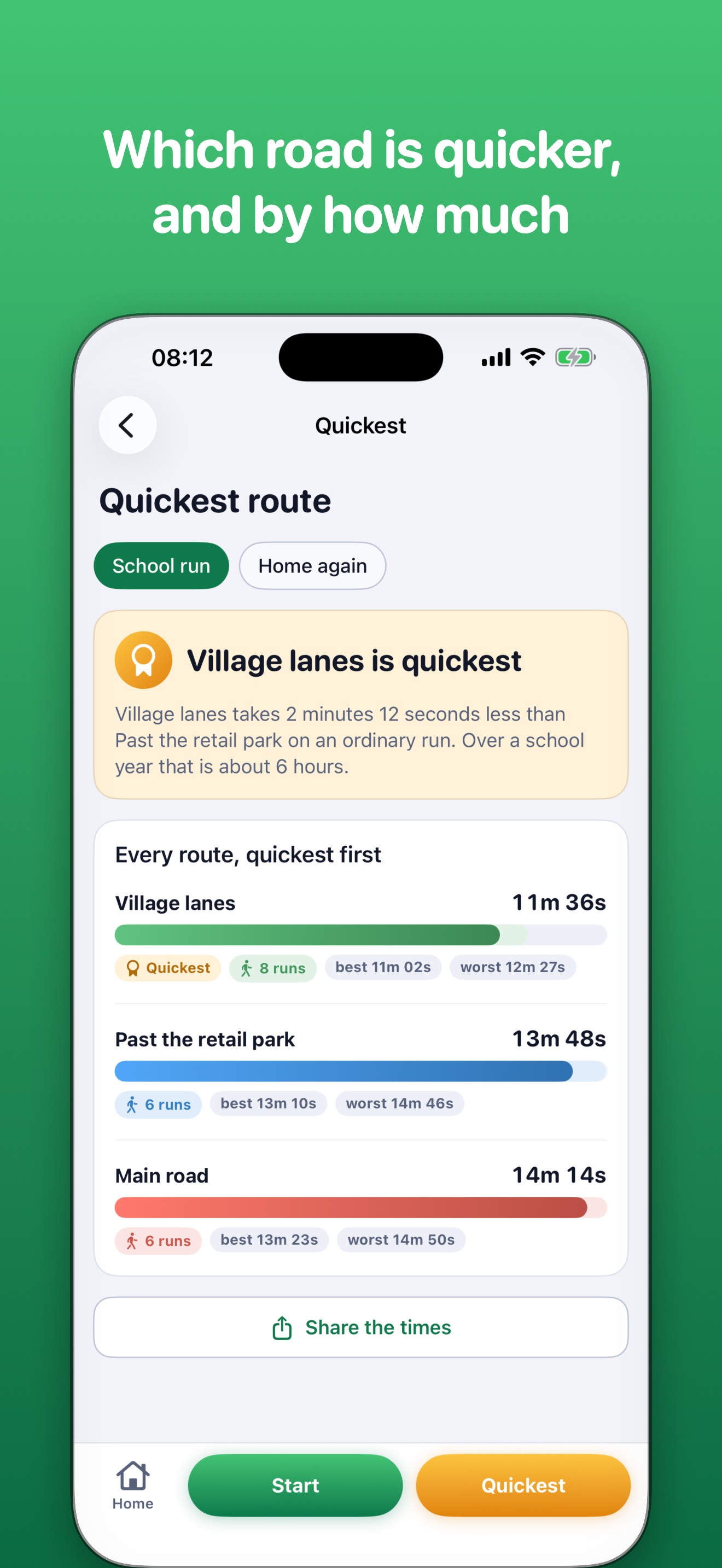
After a few runs down each road it shows every route as a bar — usual, best and worst — and names the quickest one, by how much a run, and what that saves over a school year. When two routes are genuinely too close to call, it says so instead of picking one. If you have been setting off on them at different times of day, it tells you that too.
No location, no maps, no tracking, no account, no advertising: it never asks where you are, because a stopwatch does not need to know. Everything stays on your phone, with a backup in your own iCloud.
- £1.99 once
- No in-app purchases
- No location
- iPhone only
05Questions people ask
How many times do I need to drive a route to know how long it takes?
At least three, and five or six is better. One run tells you nothing, because the same road takes a different time every morning. Three runs is the fewest from which you can see both an average and how much that road swings about.
Should I use a maps app instead?
Use it to find roads you had not thought of. Do not use it to choose between the roads you know: it is estimating an average vehicle's journey between two points, not measuring yours from your door to the school gate.
Does the time I leave matter more than the route?
Frequently, yes. Traffic on a school run builds over about twenty minutes, so ten minutes earlier can beat any change of road. It is also why a fair test means setting off at about the same time each day.
What if one route is quicker some mornings and slower on others?
Then that is the answer, and it is a useful one: the route is unreliable. Keep the best and worst times as well as the average. A road that is usually twelve minutes but occasionally twenty is a worse school run than one that is always thirteen.
Do I need to be driving?
No. Walking, cycling, the bus and the train all work the same way, and the walking routes are often where the surprises are.