A home monitoring week is two readings in the morning and two in the evening, every day for seven days. Take each pair at least a minute apart, sitting still with your back supported and the cuff level with your heart. The first day's readings are left out of the average. Write down every reading, exactly as the monitor showed it.
One reading, done properly
Technique changes the number more than most people expect, and a week of readings taken badly is worse than useless — it is misleading. The preparation is the same everywhere it is published.
- Leave half an hour after caffeine, smoking, alcohol, exercise or a meal.
- Empty your bladder. A full one pushes the reading up.
- Sit quietly for five minutes before the first measurement. Not thirty seconds.
- Sit upright with your back supported, feet flat on the floor, legs uncrossed.
- Rest the arm on a table so the cuff is level with your heart.
- Cuff on bare skin, the right size for your arm, not over a sleeve.
- Do not talk during the reading, and do not watch the display.
- Use the same arm every time, and note which one on the sheet.
Why two, a minute apart
A single measurement bounces. Taking two consecutive readings at least a minute apart, seated, and using them together smooths out the bounce. If the two are wildly different, that is itself worth writing down rather than hiding.
The week, and the day that gets thrown away
For home blood pressure monitoring, NICE asks for readings twice a day, morning and evening, for at least four days and ideally seven — and then for the first day's readings to be discarded and the average taken from the rest.
The first day runs high. A new monitor is itself a small stress, and most people are still getting the technique right on day one. Throwing that day away and keeping the other six is why you are asked for a week rather than an afternoon.
| Day | Morning | Evening | In the average? |
|---|---|---|---|
| Day 1 | 2 readings | 2 readings | No — discarded |
| Day 2 | 2 readings | 2 readings | Yes |
| Day 3 | 2 readings | 2 readings | Yes |
| Day 4 | 2 readings | 2 readings | Yes |
| Day 5 | 2 readings | 2 readings | Yes |
| Day 6 | 2 readings | 2 readings | Yes |
| Day 7 | 2 readings | 2 readings | Yes |
If your own GP or practice asked for something different — four days, or one reading a time — do what they asked. The sheet is for them.
Write down all of them
This is the one thing worth insisting on. People leave out the readings that look bad, or take a third and a fourth until they get one they like, and hand in a tidy sheet that describes somebody else.
The spread is the information. A week that runs steady and a week that swings around mean different things to the person reading it, and they cannot see that if the awkward numbers were quietly dropped. Record every reading, in the order it happened, exactly as the monitor showed it.
What goes wrong
| Mistake | What it does |
|---|---|
| Arm dangling, or held up | Changes the reading depending on how far it is from heart level |
| Feet dangling, legs crossed | Raises it |
| Talking during the measurement | Raises it |
| Cuff over a jumper sleeve | Makes it unreliable either way |
| Wrong cuff size | A cuff too small reads high |
| Straight after coffee or the stairs | Raises it |
| Swapping arms between readings | Two arms often differ; the sheet stops making sense |
The app, and what it deliberately does not do
Home Cuff is a record, not a monitor. You take the reading on your own arm cuff, and the app keeps the two numbers and the pulse exactly as the monitor showed them.
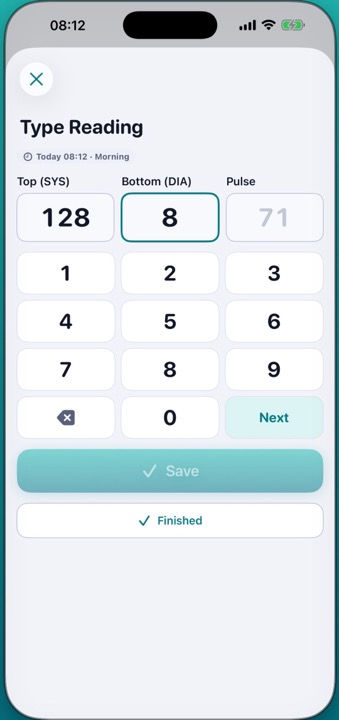
Tap New reading and there are three boxes and a large number pad, with the cursor moving on by itself. Or tap Speak reading and it asks for the top number, then the bottom number, then the pulse, aloud and on screen, showing each as it hears it and reading them back to you before it saves — all recognised on the phone, with nothing recorded and nothing sent anywhere.
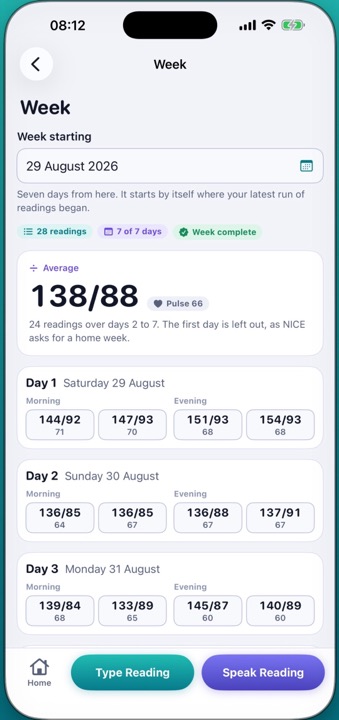
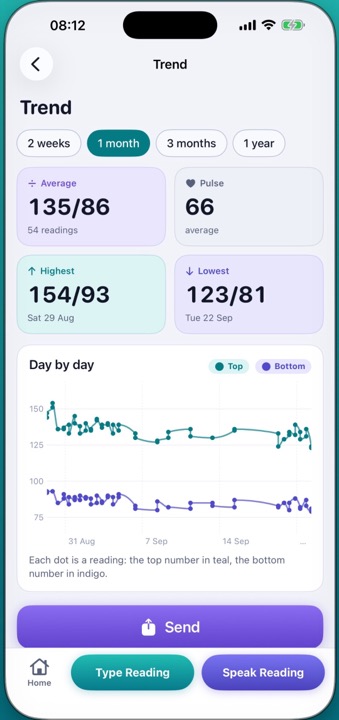
It does not judge a reading. It never says whether a number is high or low, it gives no advice, it draws no red lines and it raises no alarms. What the numbers mean is between you and your GP, and this is the sheet you take to them.
The Week page lays out two readings morning and evening for seven days the way a practice's home monitoring sheet does, works out the average leaving the first day out as NICE asks, and shows a missed reading as a gap so you can see what is still to do. Send makes the PDF.
Home Cuff: Blood Pressure Log
Ten readings free with everything working, then one purchase and no subscription. iPhone. No account, no health data collected, and it backs up to your own iCloud rather than to us. Not released yet — this page is here so it can be found when it is.
Coming soon to the App StoreQuestions people ask
- Which arm should I use?
The one your practice told you to use, and the same one every time. If nobody said, many clinicians check both once and then use the higher-reading arm from then on. Ask at the surgery rather than guessing.
- What if I miss a reading?
Leave the gap and carry on. Do not make one up and do not double up later.
- Can I use a wrist monitor?
Upper-arm cuffs are what home monitoring guidance is written around. If you already have a wrist monitor, ask your practice whether they want readings from it before doing a whole week.
- Should I take extra readings if one looks odd?
Record what you took. Repeating until you get a number you prefer is what makes the sheet meaningless.
- Does it connect to Apple Health?
No. The readings stay in the app and in your own iCloud backup.
- Is there an Android version?
No. It is an iPhone app.
This page is not medical advice. It describes how a home blood pressure monitoring week is normally carried out, drawing on published NHS, British Heart Foundation and NICE guidance about the procedure. It does not tell you what any reading means, and neither does the app. If your practice asked for something different, follow them. If you feel unwell, or a reading alarms you, contact your GP or NHS 111 — and in an emergency, 999.