A bladder diary records, for three ordinary days, every time you pass urine and how much, every drink, every leak and what you were doing, every pad change, and the times you went to bed and got up. Fill it in as you go rather than from memory. It is usually the first thing looked at in a urology, urogynaecology or continence appointment.
01What goes on the sheet
The wording varies between trusts but the rows are the same almost everywhere.
| Record | What to write | Why it is there |
|---|---|---|
| Every void | The time, and the volume in millilitres from a jug | Frequency and volume together are the pattern the clinic reads |
| Every drink | The time, the amount, and what it was | Caffeine, alcohol and total intake all change the picture |
| Leaks | The time, and what you were doing | Coughing, standing up and hurrying to the toilet point in different directions |
| Pads | How many changed, weighed if you were asked to weigh them | A rough measure of how much was lost |
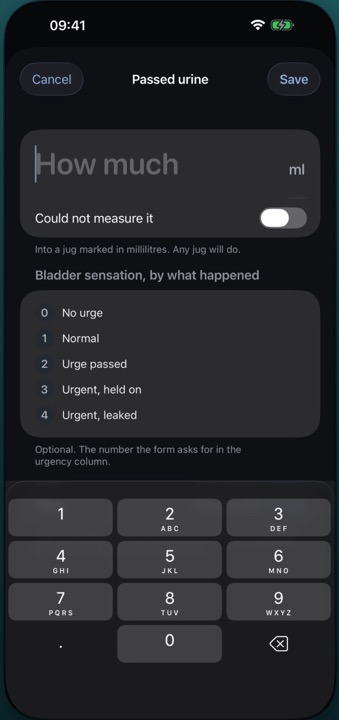
| Urgency | A 0 to 4 score, if your sheet has the column | See section 4 — there are two different scales |
| Bed and waking | The time you went to bed and the time you got up | Without these, night-time trips cannot be counted |
02Why three days, and which three
Three days is the usual request. NICE recommends a minimum of three days for women being assessed for urinary incontinence, and most continence services ask for the same.
The three should be ordinary days — days that look like your normal life, including a working day and a day off if those differ for you. A weekend of unusual drinking or a day spent in bed with flu tells the clinic nothing useful. They do not have to run one after another unless your own clinic says so.
03Measure it, do not guess
The volumes carry most of the value. Frequency alone cannot distinguish between a bladder emptying small amounts often and someone drinking three litres a day, and those are very different problems. Guessed numbers look plausible and flatten the pattern the clinic is trying to see.
- Keep a plastic measuring jug in the bathroom, not in the kitchen.
- Read it in millilitres. Most UK charts are in millilitres; US charts are often in fluid ounces.
- If measuring was genuinely impossible — out of the house, not your own bathroom — record that the void happened and mark it unmeasured. A gap is honest; an invented number is not.
- Write it down at the time. Three days reconstructed on the fourth evening is not a bladder diary.
04The diary day starts at six in the morning
This catches everyone out. The printed charts run a day from about 6am rather than from midnight, so that a trip to the toilet at three in the morning lands on the sheet for the night that is ending rather than opening a new day. It keeps each night's trips together on one row, which is the entire reason for counting them.
| Time | Void | Drink | Leak | Day |
|---|---|---|---|---|
| 21:40 | 300 ml | — | — | Tue |
| 22:55 | — | 200 ml tea | — | Tue |
| 01:20 | 180 ml | — | — | Tue |
| 04:05 | 220 ml | — | yes | Tue |
| 07:10 | 340 ml | — | — | Wed |
Both night-time voids belong to Tuesday's row, not Wednesday's. Counted the other way, Tuesday looks like an untroubled night and Wednesday looks like a disaster before breakfast.
05The two different 0 to 4 scales
This is the trap worth knowing about. There are two urgency scales in circulation on NHS bladder diaries, both numbered 0 to 4, and they do not mean the same thing.
Scale A — what happened
- Passed urine with no urge at all
- Mild urge
- Moderate urge
- Severe urge
- Did not reach the toilet in time
Scale B — how long you could have waited
- No urgency
- Could have put it off as long as necessary
- Could have put it off for a short while
- Could not have put it off
- Had to rush and did not make it
A 3 on one sheet is not a 3 on the other. Whatever you use, make sure the full wording of your scale is printed alongside your numbers, so nobody in the clinic has to guess what you meant.
06Four published forms
You will have been handed one of these. They record the same events in different shapes.
| Form | Shape |
|---|---|
| Three-day bladder diary (NHS trusts and continence services) | Hourly rows, millilitres, a 0 to 4 score, leaks with a reason, pads |
| Daily bladder diary (NIDDK, and the Urology Care Foundation version) | Hourly bands, trips counted, leaks small, medium or large |
| Frequency volume chart | The times and the volumes, and nothing else |
| Plain timed list | Exact times in order |
07The app, and what it will not do
Bladder Diary & Chart is that sheet on the phone, with four buttons pinned to the bottom of the screen so they cannot be scrolled past at two in the morning. The amount box is already open and waiting when you tap I went. The diary day runs from six, the way the printed forms do. Pick the form you were handed; change your mind later and it reprints on another without altering anything you recorded.
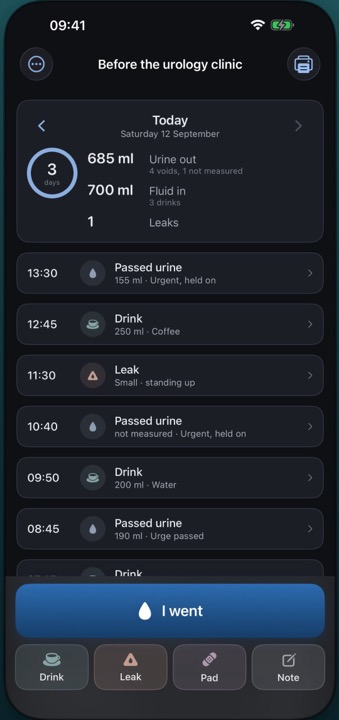
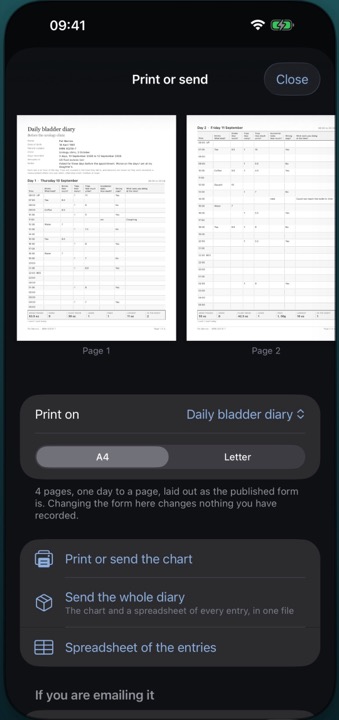
It does not interpret anything. It records what you write down and prints it. It does not score your symptoms, work anything out about them, compare you with anybody, or tell you what any of it means. Reading a bladder diary is the job of the clinician who asked for one.
Recording is free and unlimited, forever, on as many days as you like, and the free version prints the first two pages of the chart so you can see exactly what the finished thing looks like. One purchase, no subscription, prints every page with its totals, sends the whole diary as one file, and adds more than one diary for the days before and after treatment.
Bladder Diary & Chart
Free to download, and recording is free and unlimited. One purchase, no subscription, Family Sharing included. iPhone, United Kingdom and United States. Millilitres or fluid ounces, A4 or US Letter.
Get it on the App Store08Questions people ask
- Do the three days have to be in a row?
Not usually, unless your clinic says so. They do need to be typical days.
- What if I forget to measure one?
Record that it happened and mark it unmeasured. Do not invent a figure.
- Should I drink less to make the chart look better?
No. Change nothing about your normal routine while you are keeping it. A diary of a life you do not lead is no use to anyone, and the clinic is looking precisely at your ordinary pattern.
- Does it work with no signal?
Yes, entirely. It works in aeroplane mode, there is no account and nothing is ever uploaded.
- Can I send it to the clinic before the appointment?
Yes, as a PDF, with a passphrase on it if you want one. Your copy stays on the phone either way.
- Is there an Android version?
No. It is an iPhone app only.
This page explains what bladder diaries ask for and how they are normally filled in. It is general information about a form, not medical advice, and it cannot tell you what your own results mean. The app records and prints what you enter and interprets nothing. If you have symptoms that worry you, speak to your GP, your continence service or your specialist.