Photograph every room before you unpack anything. What is already scratched, stained, chipped or broken goes in the pictures with the date on them. Then the meters, the keys and the alarms. Email your landlord a dated record the same day and ask them to reply within seven days if they disagree. Do the whole thing again on the last day.
The agent's inventory is not your record
You will probably be handed one. It is the landlord's document, made for the landlord, and it is often a page of ticked boxes and a handful of small photographs. You get a short window to comment and almost nobody does, because you are carrying boxes up a stairwell at the time.
Nine months later, someone will look at a mark on a carpet and ask whether it was there when you arrived. What decides that question is not what you remember. It is what somebody can show.
How the argument is actually settled
In England and Wales, a deposit on an assured shorthold tenancy must be held in a government-approved scheme — within 30 days of the landlord or agent receiving it, with the prescribed information given to you in the same period. Scotland and Northern Ireland run their own schemes on their own timetables.
If you dispute a deduction, every scheme offers free adjudication. This is the part worth understanding:
An adjudicator never visits the flat. They read what both sides send in and decide on the papers alone. There is no hearing, no site visit and no cross-examination. It is a documents case — so the tenant with forty dated photographs from day one is in a completely different position from the tenant with a memory and a grievance.
The landlord has to justify a deduction; it is not for you to disprove it. But that only helps if there is something to set against their version, and a dated set of photographs sent to them on day one is about the strongest thing a tenant can hold.
What to photograph, room by room
Wide shots first, from two opposite corners, so the room is recognisable. Then close on anything already wrong. Do it with the flat empty — once your boxes are in, half of it is hidden for a year.
Every room
- Two wide shots from opposite corners
- Carpet, and its edges and corners
- Walls behind doors and behind where furniture stood
- Skirting, sockets, switches, light fittings
- Window frames, sills, locks and keys
Kitchen
- Inside the oven, and the grill pan
- Inside the fridge and freezer
- Worktops, chips in the edges, sealant
- Under the sink, and the cupboard floors
- Extractor filter
Bathroom
- Bath and shower tray, and the seals
- Grouting, and any mould
- Basin, toilet, cistern, any cracks
- Extractor fan, and whether it runs
The rest
- Any damp, condensation or mould, anywhere
- Garden, balcony, bins, shed
- Communal hall or stairs if they are yours to keep
- How clean it was handed over — room by room
And the three that are not rooms
- Meters. One photograph of each, with the dials and the date in the same picture. Gas, electricity, and water if you are billed for it. This settles a different argument entirely, with the energy supplier.
- Keys. How many of each, photographed together. Missing keys are a common and expensive deduction, because a lock change gets charged.
- Alarms. Test the smoke and carbon monoxide alarms on day one and record that they worked and when you tested them.
Fair wear and tear, or damage
You cannot be charged for ordinary deterioration over the length of the tenancy. The line is not always obvious, but adjudicators draw it roughly here.
| Wear and tear — not chargeable | Damage or cleaning — chargeable |
|---|---|
| Carpet flattened along a hallway | A burn, or a large stain |
| Paint dulled, small scuffs | Holes, or a wall repainted a new colour |
| A worn bath seal | A cracked basin or a chipped bath |
| Limescale on an old tap | An oven left dirty |
| A tired, ageing kitchen worktop | A knife cut or a scorch mark |
| Curtains faded by the sun | Curtains torn or missing |
There is also a rule that catches landlords out: they cannot charge you for replacing something old with something new and pocket the improvement. If a ten-year-old carpet is ruined, the claim is for what was left of its life, not for a brand new one.
Four steps on the day
- Walk it emptyBefore a single box comes in. Wide shots, then close-ups of anything wrong.
- Meters, keys, alarmsOne photograph of each meter, the keys laid out together, and the alarms tested.
- Send it the same dayBy email, so the timestamp belongs to neither of you. Attach the record and ask for a reply within seven days if they disagree.
- Keep it somewhere safeA tenancy usually outlasts a phone, and day one cannot be photographed twice.
And on the last day
Do it again, in the same order, from the same places. Two sets of photographs taken from the same spot at either end of a tenancy are far more persuasive than either set alone, because they answer the only question that matters: was this here when I arrived?
The app that keeps it in order
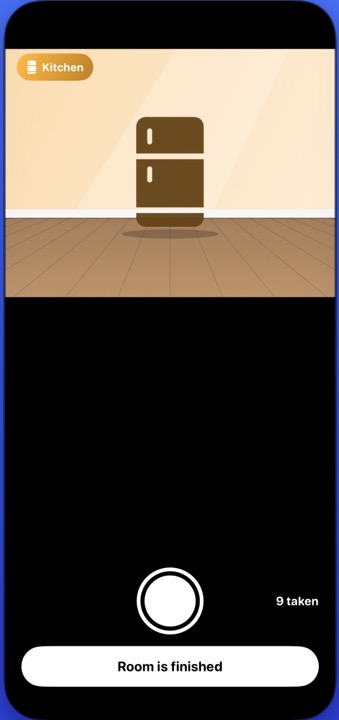
Just Moved In is that walk, with the paperwork done for you. The usual rooms are already there, so there is nothing to set up. Choose a room, press the button, and the camera stays open: every photograph is kept the moment it is taken, with its date and time, which cannot be edited in the app.
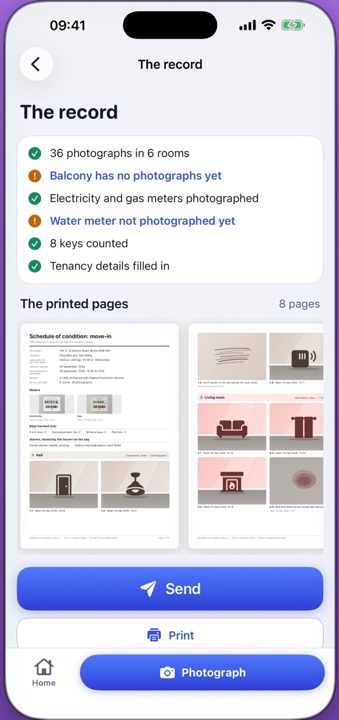
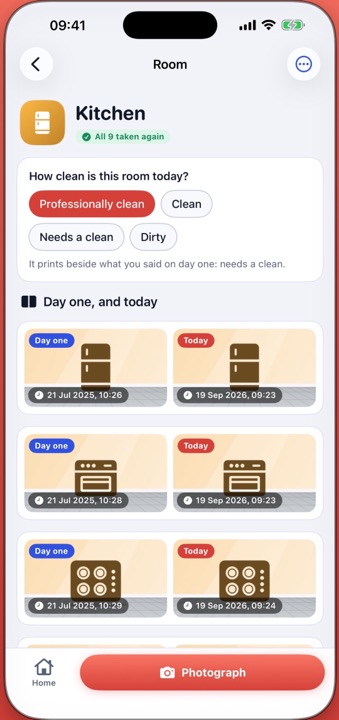
One tap records how clean each room was, because cleaning is what deposits are argued over most. One photograph of each meter. Count the keys. Record whether the alarms worked. A checklist shows what is still missing — a room with no photographs, a meter not read — before you send.
Send opens an email already addressed to your landlord with the PDF attached and the covering words written; you press send. On the day you leave, day one appears in the corner of the camera so today's photograph matches it, and the move-out record prints the two side by side. Your move-in record is never changed by any of it.

Just Moved In
Ten photographs free with everything working, then one purchase for every home you ever rent. No subscription. iPhone, UK and US. Backs up to your own iCloud, never to us. Not released yet — this page is here so it can be found when it is.
Coming soon to the App StoreQuestions people ask
- Is the agent's inventory enough?
It is their document, not yours. Comment on it in writing if you disagree, and keep your own record as well.
- What if I already moved in last week?
Do it today. A record made in week one is still enormously better than nothing, and you should say plainly in the covering email when the photographs were taken.
- Does my landlord have to accept it?
They do not have to agree with it. But if you sent it at the start and they never disputed it, that silence carries weight later.
- How many photographs is enough?
A typical one-bedroom flat comes out at thirty to forty. It is better to take too many; you only ever need the one nobody thought to take.
- What about a house share?
Photograph your own room in full detail and the shared areas as they were. Deductions from a joint deposit are usually argued jointly.
- Is there an Android version?
No. It is an iPhone app.
This page is general information about keeping a record of a rented home, drawn from the deposit schemes' own published guidance and gov.uk. It is not legal advice, it cannot promise the outcome of a dispute, and the rules differ between England and Wales, Scotland and Northern Ireland. For advice on your own tenancy, speak to Citizens Advice, Shelter, or a solicitor.