A home inventory is a photographed, dated list of what you own, made before anything happens. After a fire, flood or burglary the contents claim is settled item by item and it is you who has to say what was there. Walk the house with a phone, photograph each thing, note roughly what it cost, and keep a copy somewhere other than the house.
Why the claim needs it
Every insurer and every loss adjuster gives the same advice: go round the house with a camera before you ever need to. Almost nobody does it, and the reason is not laziness. It is that every app which offers to help turns into an afternoon of typing model numbers into forms.
The consequence turns up at the worst moment. A contents claim is not settled as a lump sum for “the living room”. It is settled item by item, against a list that the policyholder has to produce, from memory, days after losing everything. People forget the curtains, the tools in the shed, the contents of the wardrobe, the things in the loft. Then they under-claim, and never find out by how much.
What to record for each thing
| Record | Why |
|---|---|
| A clear photograph | Proves it existed, and shows its condition and quality far better than a description |
| What it is, in plain words | “Grey three-seater sofa, John Lewis, about 2021” is enough. It does not need to read like a catalogue |
| Roughly what it cost | An honest estimate beats a blank. It gives the adjuster a starting figure |
| Serial and model numbers | For anything electrical or stealable. Photograph the plate on the back rather than typing it |
| Receipts, if you have them | Useful, not essential. Do not let a missing receipt stop you recording the item |
| The date | Written by the camera into the photograph. It is what makes the list evidence rather than a claim |
Room by room, so nothing is missed
Work in one direction round each room, then open every cupboard. The forgettable things are worth more in total than the obvious ones.
Living room
- Sofas, chairs, tables
- Television, sound bar, consoles
- Rugs, curtains, blinds
- Pictures, mirrors, lamps
- Books, records, ornaments
Kitchen
- Freestanding appliances
- Small appliances in cupboards
- Pans, china, glassware, cutlery
- Contents of the freezer
- Table and chairs
Bedrooms
- Beds, wardrobes, chests
- Clothing by the rail, not by the item
- Shoes, coats, bags
- Jewellery and watches, photographed closely
- Anything on top of the wardrobe
The forgotten places
- Loft, garage, shed, cellar
- Bicycles, tools, garden machinery
- Camping and sports kit
- Christmas decorations
- The under-stairs cupboard
The limit that catches people out
The single article limit. Most contents policies cap what they will pay for any one item unless you have named it on the policy. The cap is commonly somewhere between one and two thousand pounds, but it varies a great deal between insurers — check your own schedule rather than assuming. An engagement ring, a bicycle, a camera, a laptop or a musical instrument can sit above it easily and be paid out at the cap instead of at its value.
Making the inventory is how you find these. As you go round, anything you would struggle to replace for a thousand pounds is worth a second look at the policy schedule. It is a far better time to discover the problem than after the event.
And the total
The same walk tells you whether the sum insured on the policy is anywhere near the truth. Most people guess low, because they think of the furniture and forget the clothes, the kitchen and the loft. If you are insured for less than the contents are worth, some policies reduce the payout on every claim in proportion, not just on the big one.
Keep the copy somewhere else
This is the part people get wrong after doing all the work. An inventory exists to survive the event that destroys the contents. If the only copy is on a laptop in the house, or printed in the filing cabinet, it goes up with everything else.
- Email the PDF to yourself, so it lives in your mail account.
- Put a copy in whatever cloud storage you already use.
- Print one and leave it with a relative or in a desk at work.
- Do all three. It is one file.
The app that makes it an evening, not an afternoon
Home Inventory removes the typing, which is the only reason the job never gets done. Photograph a thing. The microphone is already listening, so you just say what it is: what it is, where it came from, roughly what it cost. Tap save. That is one item. A sofa takes ten seconds.
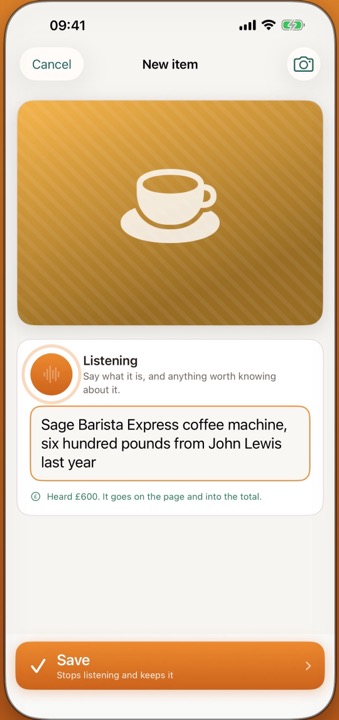
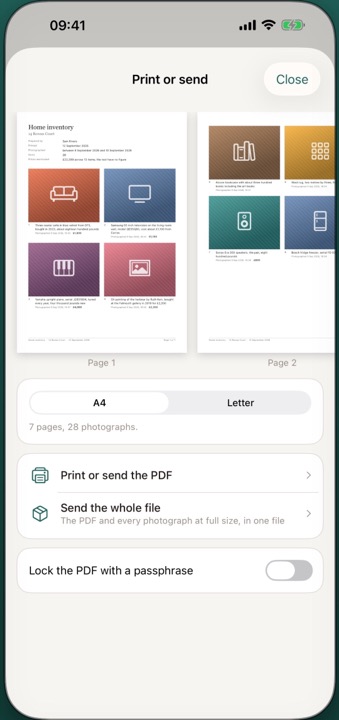
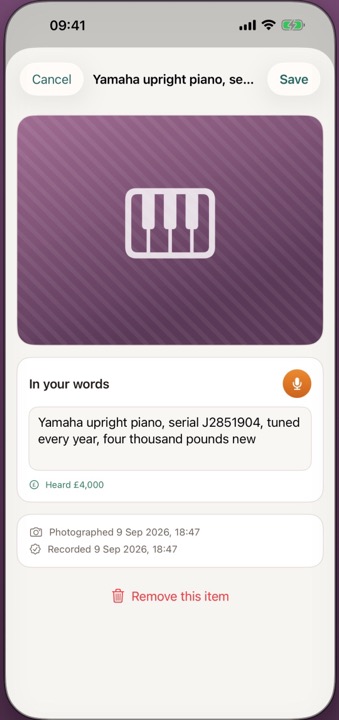
When you have been round, print the lot: each photograph at a size an adjuster can actually see, two to a page, with your words underneath and the date the camera wrote into the picture. Any prices you mentioned are printed beside the item and added up on the last page. You can also send the whole thing as one file with every photograph at full size.
Dictation runs on the phone with Apple's on-device recogniser, so your voice never leaves it. A photographed list of everything you own is about the most private file a phone can hold, so there is no account, no sign-in and no server: nothing is uploaded, ever.

Home Inventory & Contents List
Free to download, and photographing and describing your things is free and unlimited. One purchase prints every page, with no subscription and Family Sharing included. iPhone, worldwide.
Get it on the App StoreQuestions people ask
- Do I need receipts?
They help but they are not essential. A dated photograph and an honest description is a great deal more than most claimants can produce. Never let a missing receipt stop you recording something.
- Do I need a professional valuation?
Not for ordinary contents. For jewellery, art or antiques above the single article limit, your insurer may ask for one before they will specify the item.
- How detailed should clothing be?
By the rail, not by the item. Photograph the open wardrobe and say roughly what is in it. Then record coats, suits, boots and anything else individually expensive.
- How often should I go round again?
Twice a year, and whenever something expensive arrives. The app can remind you.
- Does anything get uploaded?
No. There is no account and no server. The only copies are the ones you make yourself.
- Is there an Android version?
No. It is an iPhone app only.
This page is general information about keeping a contents list. It is not insurance advice, and policies differ a great deal — your own schedule and policy wording are what decide what is covered, what the single article limit is, and how a claim is settled. Check them, or ask your insurer or a broker.