A game is ten frames of up to two balls. An open frame scores the pins you knocked down. A spare scores 10 plus your next ball. A strike scores 10 plus your next two balls. That bonus is the whole game: it is why one frame can be worth 30, why a perfect game is 300 and not 100, and why your score sits unfinished until the balls after it are bowled.
The marks
A real game, frame by frame
201, with an open frame, a double, a triple and a spare in the tenth.
| 1 | 2 | 3 | 4 | 5 | 6 | 7 | 8 | 9 | 10 |
|---|---|---|---|---|---|---|---|---|---|
X 20 |
7/ 39 |
9– 48 |
X 78 |
X 106 |
X 125 |
81 134 |
6/ 154 |
X 181 |
X7/ 201 |
| Frame | How it was scored | Worth | Running |
|---|---|---|---|
| 1 — X | 10 + the next two balls (7 and 3) | 20 | 20 |
| 2 — 7 / | 10 + the next one ball (9) | 19 | 39 |
| 3 — 9 – | Open. Just the pins | 9 | 48 |
| 4 — X | 10 + the next two balls (10 and 10) | 30 | 78 |
| 5 — X | 10 + the next two balls (10 and 8) | 28 | 106 |
| 6 — X | 10 + the next two balls (8 and 1) | 19 | 125 |
| 7 — 8 1 | Open | 9 | 134 |
| 8 — 6 / | 10 + the next one ball (10) | 20 | 154 |
| 9 — X | 10 + the next two balls (10 and 7) | 27 | 181 |
| 10 — X 7 / | All three balls, no further bonus | 20 | 201 |
Look at frames 4, 5 and 6. Three identical strikes worth 30, 28 and 19, purely because of what happened afterwards. That is the part people find strange, and it is the whole reason the score on the lane's screen waits before it fills in.
The tenth frame
Every other frame collects its bonus from the frames that follow. The tenth has nothing following it, so it borrows the balls instead.
- Strike first ball? Two more balls, so three in total.
- Spare in two? One more ball, so three in total.
- Neither? Two balls, like any other frame.
The extra balls only count towards the tenth frame; they do not start an eleventh.
Handicap, and why leagues use it
League handicap exists so a bowler averaging 150 can compete against one averaging 200 on the same night. It gives you a share of the gap between your average and a basis score the league picks.
handicap = (basis − your average) × percentage
Rounded down, and never less than zero. 80% of 200 and 90% of 220 are both common.
A bowler averaging 165 in a league using 80% of 200: (200 − 165) × 0.8 = 28 pins a game, so a scratch 178 becomes 206 with handicap. A bowler averaging over the basis normally gets nothing, which is the point.
Averages are usually recalculated as the season goes on, so the handicap moves with your form. Until you have bowled enough games, leagues generally give you an entering average to start from.
The words at the lane
| Clean game | No open frames. Every frame closed with a strike or a spare. |
| Double, turkey | Two strikes in a row, then three. |
| Perfect game | Twelve strikes, 300. |
| Dutch 200 | Alternating strikes and spares all the way through, which lands on exactly 200. |
| Split | The headpin is down and there is a gap between the pins left. The 7–10 is the famous one. |
| Series | The night's games added together. Three games is the usual league night, so 600 is the number people chase. |
The app that does the arithmetic
Ernie's Bowling Score Keeper puts the ten frames up with the pins as you see them from the approach. After each ball, tap the pins still standing — usually none, or one — and press Strike, Spare or Next. A frame is one or two taps, and the running score fills in exactly as it does on the lane's screen, waiting for the bonus balls.
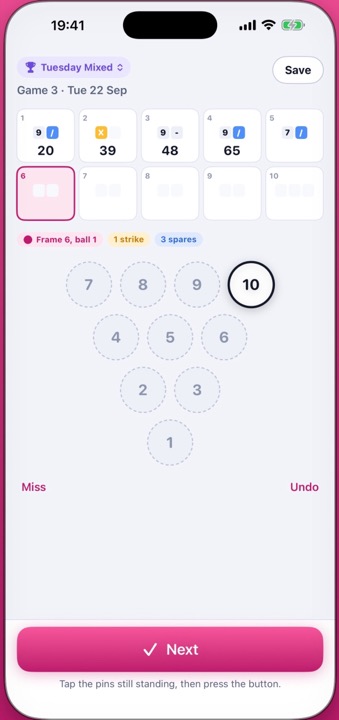
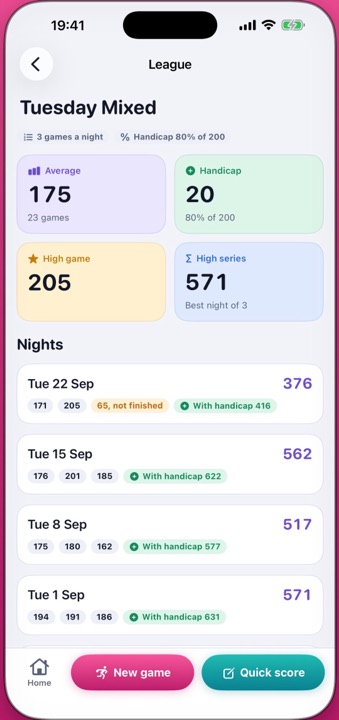
A league is just a name, how many games a night and the handicap rule, and tonight already belongs to the league that usually bowls on this weekday, so there is nothing to answer before the first ball. No time to score ball by ball? Quick score keeps the final score alone in three taps, and it still counts in your average and the night's series.
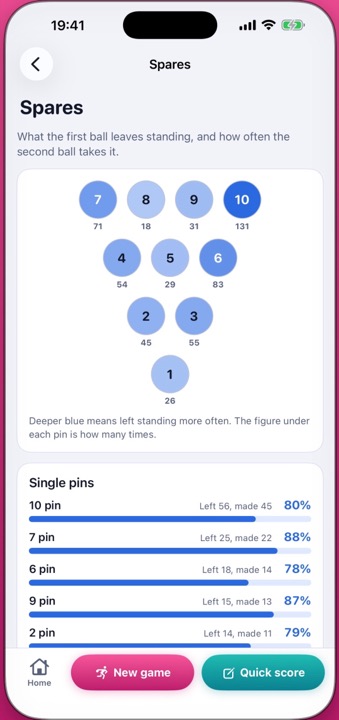
The Spares page shades the deck by how often each pin is left standing, and shows for each single pin how often you pick it up — along with splits and the bigger leaves, with the commonest named.

Ernie's Bowling Score Keeper
Ten games free with everything working, then one purchase and no subscription. iPhone. Everything is worked out on the phone, and it works below ground with no signal. With Apple for review — this page is here so it can be found when it lands.
Coming soon to the App StoreQuestions people ask
- Why is a perfect game 300 and not 120?
Because each strike collects the next two balls. Twelve strikes make every frame worth 30, and ten frames of 30 is 300.
- Why does my score not appear straight away?
A strike cannot be scored until two more balls have been bowled, and a spare until one has. The lane's screen is doing the same thing.
- Do the tenth-frame bonus balls score on their own?
No. They only add to the tenth frame.
- How many games before I have an average?
Leagues vary; many use an entering average for the first few nights and then switch to your own. The app uses the league's starting average until you have bowled.
- Does it work for five-pin or candlepin?
No. It scores ten-pin.
- Is there an Android version?
No. It is an iPhone app.
Scoring rules here are the standard ten-pin rules as bowled in leagues and houses. Individual leagues set their own handicap basis and percentage, and their rules are the ones that count on the night.