Antiques LedgerMargin scheme
For antiques dealers · UK VAT margin scheme · iPhone
HMRC wants a stock book: every item, the date, who you bought it from, what you paid, then who bought it, for how much, the margin and the VAT due.
Photograph the piece and say what you paid. That is the whole job. The book, the invoices and the VAT figures write themselves.
no spreadsheet. no shoebox.
no January panic.
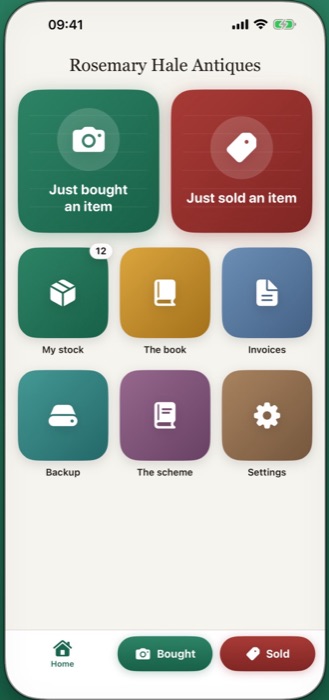
The VAT margin scheme stock book needs a line for every item. Stock number, the date you bought it, who from, the invoice number, a description and the purchase price — then the date of sale, the invoice number, the buyer, the selling price, the margin and the VAT due on that margin. VAT is charged on the margin only, at one sixth of it, and an item sold at a loss carries none.
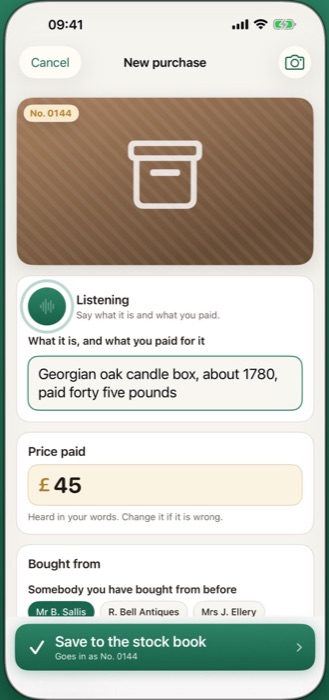
One button. Photograph the piece. The microphone is already listening, so say what it is and what you paid — “Georgian oak candle box, about 1780, paid forty five pounds” — and the price is picked out of your own words.
The next stock number is given out, and never reused. Tap a seller you have bought from before, or type a name and address.
Buying from a private person? The scheme says you must make out the purchase invoice yourself. The app does it as you save: numbered to match the stock number, worded the way HMRC asks.
Photograph it again. The app compares your picture with the photographs of everything still in your stock — on the phone, in a moment — and puts the closest pieces in front of you. Tap the right one.
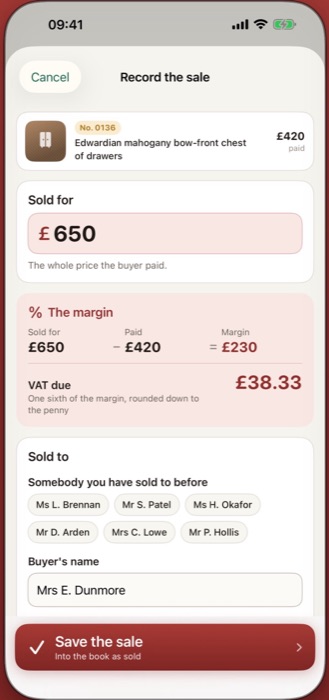
Type the price and watch the sum do itself: the margin, then one sixth of it as VAT, and nothing at all when the piece went out at a loss.
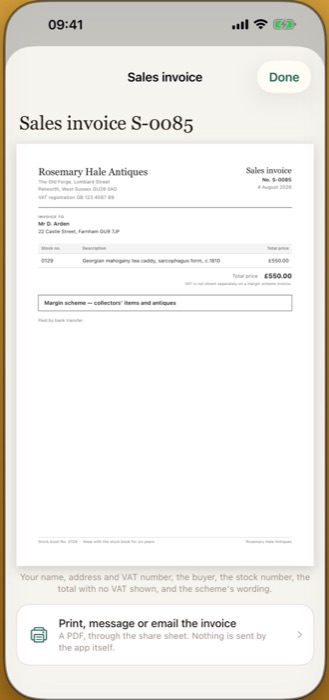
The sales invoice is numbered in sequence, carries the scheme's exact wording, and never shows VAT separately — because under the margin scheme it must not.
“Margin scheme — collectors' items and antiques”
printed on every sales invoice
Quarter ending 30 September
Open the book on any VAT quarter. The return figures are worked out from your own lines, and the printed pages are already laid out in HMRC's columns: purchases on the left, sales on the right, totals at the foot.
Box 1
£91.65
VAT due on the margins
Box 6
£1,333.35
Selling prices, less the VAT due
Box 7
£2,545.00
Purchase prices in the period
Figures from the demonstration book. Margin-scheme goods only.
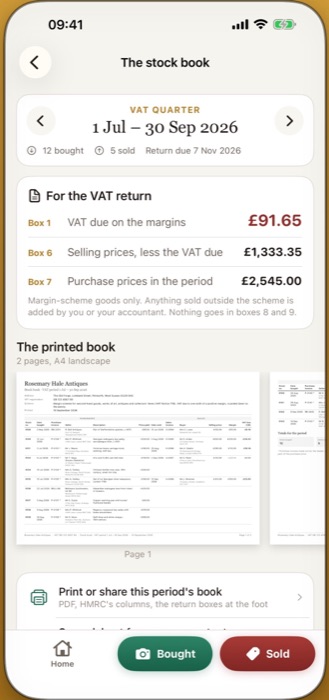
Swipe the book sideways →
| Stock no. | Date bought | Seller | Price paid | Date sold | Buyer | Selling price | Margin | VAT due |
|---|---|---|---|---|---|---|---|---|
| 0126 | 2 May 2026 | R. Bell Antiques | £95.00 | 10 Jul 2026 | Mrs C. Lowe | £150.00 | £55.00 | £9.16 |
| 0129 | 12 Jun 2026 | Mrs R. Whitlock | £320.00 | 4 Aug 2026 | Mr D. Arden | £550.00 | £230.00 | £38.33 |
| 0131 | 3 Jul 2026 | Mr J. Reeve | £180.00 | 2 Sep 2026 | Mr M. Okafor | £295.00 | £115.00 | £19.16 |
| 0133 | 9 Jul 2026 | Mr T. Nagy | £140.00 | 2 Sep 2026 | Mrs J. Lynas | £120.00 | −£20.00 | £0.00 |
| 0134 | 10 Jul 2026 | Mrs A. Fairley | £280.00 | — | still in stock | — | — | — |
The whole period as a PDF through the share sheet, or the same columns as a spreadsheet for your accountant. Nothing is sent by the app itself.
Already number your stock and your invoices? Set your own prefix and starting number and the app carries on from the system you use now. Numbers in the book never change.
Sales invoices with your name, address and VAT number, the buyer, the stock number and the total with no VAT shown — carrying the wording the margin scheme requires, numbered in sequence.
Purchase invoices made out by you when you buy privately, which is the scheme's own rule and the one most often missed at an inspection.
Every invoice is kept in the app, and any of them can be printed, messaged or emailed from the share sheet.
A stock book holds names, addresses and prices. So there is no account, no sign-in and no server of ours. The book lives on your phone, and nothing in it ever comes to us.
The dictation and the photograph matching both run on the device. It works in a field with no signal, and you can lock it behind Face ID.
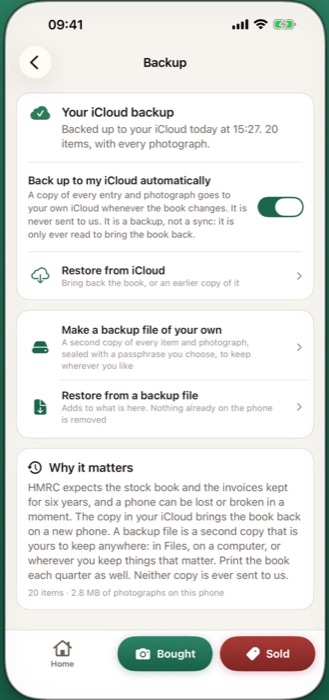
HMRC expects six years of records, and a phone can be lost in a moment. A backup copy goes to your own iCloud whenever the book changes, and a new phone offers the book back, photographs and all. It is a backup, not a sync — we cannot see it. For a second copy, make a backup file sealed with a passphrase only you know.
The price
Put five real items through the book with everything working — buying, selling, the invoices, the printed pages, the spreadsheet, the backups. If it suits the way you trade, unlock it.
£39.99
A year
Renews each year until you cancel, and you can cancel at any time in your Apple Account settings.
£129.99
Once, and never again
One payment, no renewal, and it includes Family Sharing. About three years of the subscription — and then it stops.
The rules behind it
The margin scheme exists because second-hand goods have usually borne VAT once already. Rather than charging VAT again on the whole selling price, you charge it only on what you added — the margin. The price of that concession is the record-keeping.
| When you buy | When you sell |
|---|---|
| Stock number Date of purchase Purchase invoice number Seller's name and address Description of the item Purchase price |
Date of sale Sales invoice number Buyer's name Selling price The margin The VAT due on the margin |
Entries are kept in stock number order, each item standing on its own line from the day it arrives to the day it leaves. If any part of an item's entry is missing, HMRC can refuse the scheme for that item — and then the VAT is due on the whole selling price, not on the margin.
The margin is the selling price less the purchase price. The VAT due is the VAT fraction of the margin, which at a 20% rate is one sixth. Not one fifth: the margin already includes the VAT.
| Stock | Paid | Sold | Margin | VAT due |
|---|---|---|---|---|
| 0131 — Georgian mahogany chest | £200 | £500 | £300 | £50.00 |
| 0132 — Pair of brass candlesticks | £60 | £145 | £85 | £14.17 |
| 0133 — Victorian washstand | £340 | £300 | nil | £0.00 |
Stock 0133 is the row worth understanding. A loss produces no margin and therefore no VAT — and under the standard scheme it cannot be set against the profit on the chest either. Every item stands alone.
A margin scheme invoice must not show a VAT amount, because there is none to reclaim: that is the bargain. It carries the scheme's own wording instead. You need an invoice for the purchase as well as the sale, and for a private seller that usually means one you write yourself and both of you sign.
HMRC's rules are published in VAT Notice 718: the Margin Scheme and Global Accounting. Where this page and the Notice differ, the Notice is right.
Questions
One sixth of the margin at a 20% rate. Selling price minus purchase price, then divide by six.
No margin, so no VAT on that item — and it cannot be offset against a profit elsewhere under the standard scheme.
No. There is none to reclaim, and the invoice must not show a VAT amount.
You write one and you both sign it. Without a purchase invoice carrying the required details, that item is not eligible for the scheme.
No. It keeps the standard margin scheme's item-by-item stock book, in pounds, for dealers in the United Kingdom.
No. It gives you the figures for boxes 1, 6 and 7 and the printed stock book behind them. It does not connect to HMRC or to any bank.
It keeps the standard margin scheme's item-by-item stock book for dealers in the United Kingdom, in pounds sterling. It does not do Global Accounting, it does not submit your VAT return, and it does not connect to HMRC or to any bank.
It is a record-keeping aid, not tax advice. The rules are HMRC's, in VAT Notice 718. If your position is not straightforward, speak to your accountant.